

Korea Institute of Energy Research
Korea Institute of Energy Research (KIER)
Energy-Efficient Electrostatic Precipitation Technology
This is an industrial electrostatic precipitator technology that reduces power consumption while minimizing the risk of vapor fires.
Technology Overview
Low-Energy Electrostatic Precipitation Technology That Ensures Both Fire Safety and Energy Efficiency
A highly stable, intelligent dust collection solution capable of treating high-moisture, flammable exhaust gases
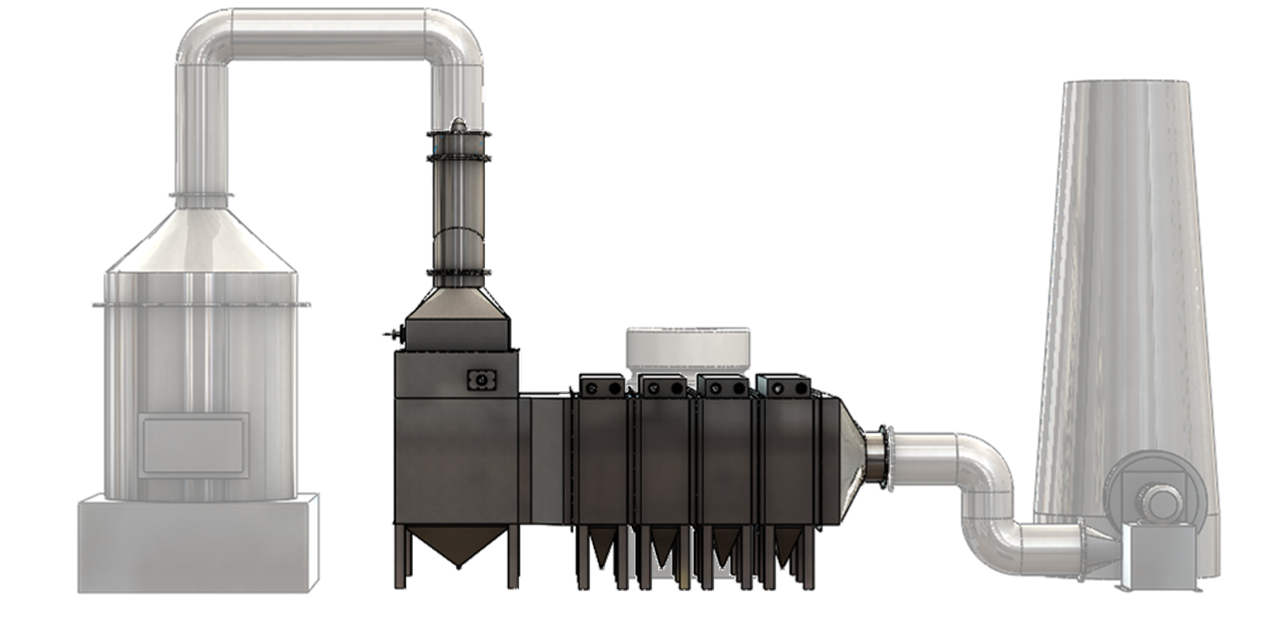
Technology Configuration
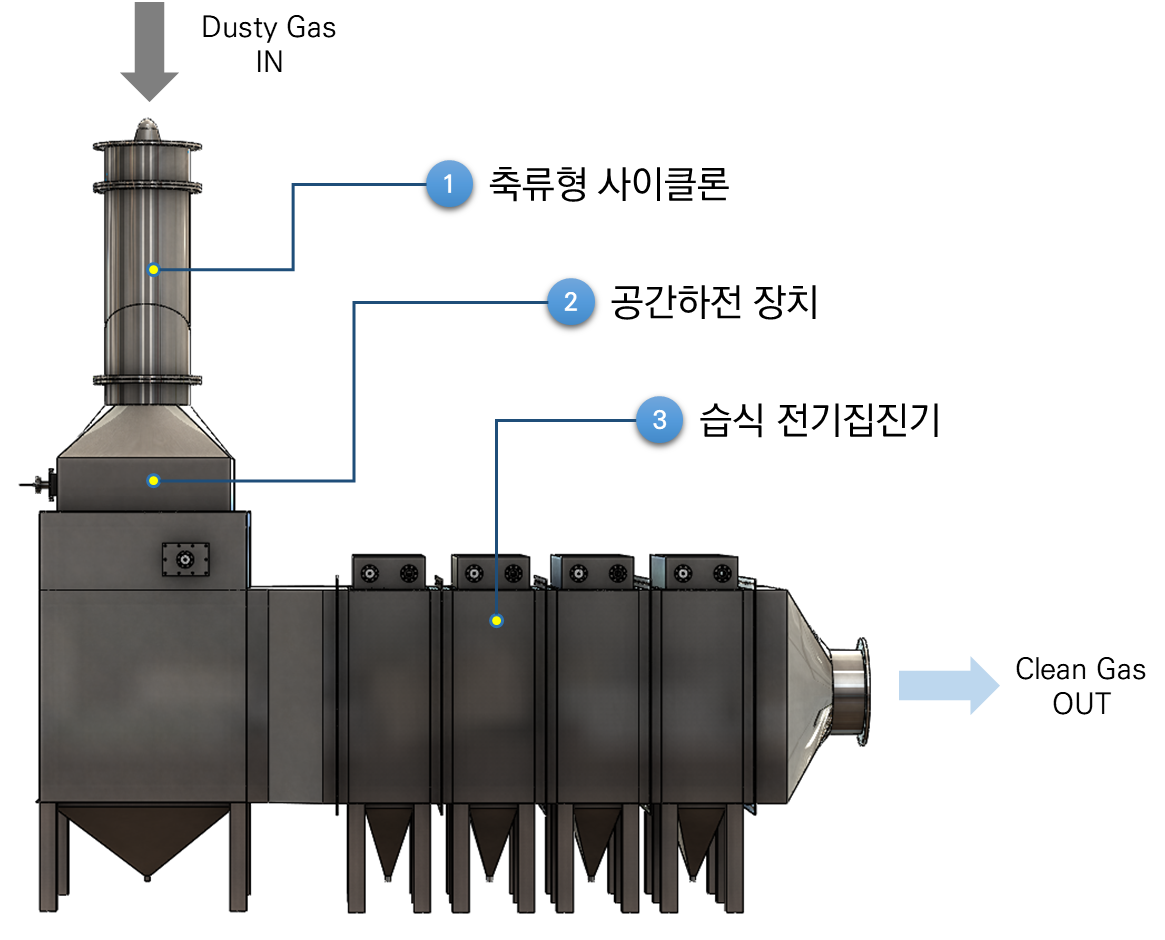
Axial-Flow Cyclone
Selective removal of coarse particles and moisture droplets at the shear zone of the space-charging unit, which uses high voltage (removes 99.9% or more of particles 20 μm or larger)
Improves operational stability and prevents the occurrence and spread of fires by separating coarse particles and moisture droplets (flammable materials) from the spatial charging device (ignition source)
Spatial Charging Device
Technology that electrically ionizes exhaust gas to generate high-concentration gas ions and imparts static electricity to the material being treated
Structural stability technology ensures stable operation without spark discharge, even under conditions of excessively humid exhaust gas
Wet Electrostatic Precipitator
Utilizes the electro-wetting phenomenon to charge dielectric-coated electrodes with electrical energy
Generates and maintains a strong electric field using the stored electrical energy
The use of dielectric-coated electrodes maintains excellent dust collection performance while suppressing fires caused by spark or arc discharges
Key Features of the Technology
Minimized Fire Risk: The combination of a co-current cyclone, spatial charging, and dielectric-coated electrodes eliminates the possibility of fire at the source
Easy Maintenance: Dust collection plates can be cleaned at any time during operation thanks to the dielectric-coated electrodes
High-Moisture Gas Treatment: Stable operation even in environments with high-moisture droplet inflow, such as downstream of a scrubber
Minimized Operating Costs: Utilizes the phenomenon of electrical wetting to minimize the energy required to generate an electric field
Maximized Treatment Efficiency: Treatment efficiency is maximized by forming and maintaining a high-intensity electric field
Experimental and Demonstration Data
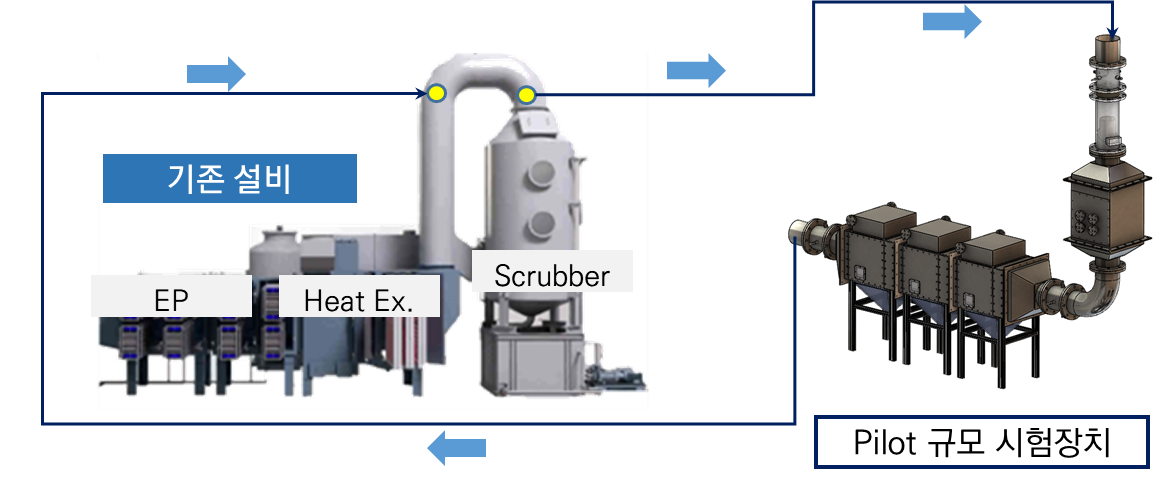
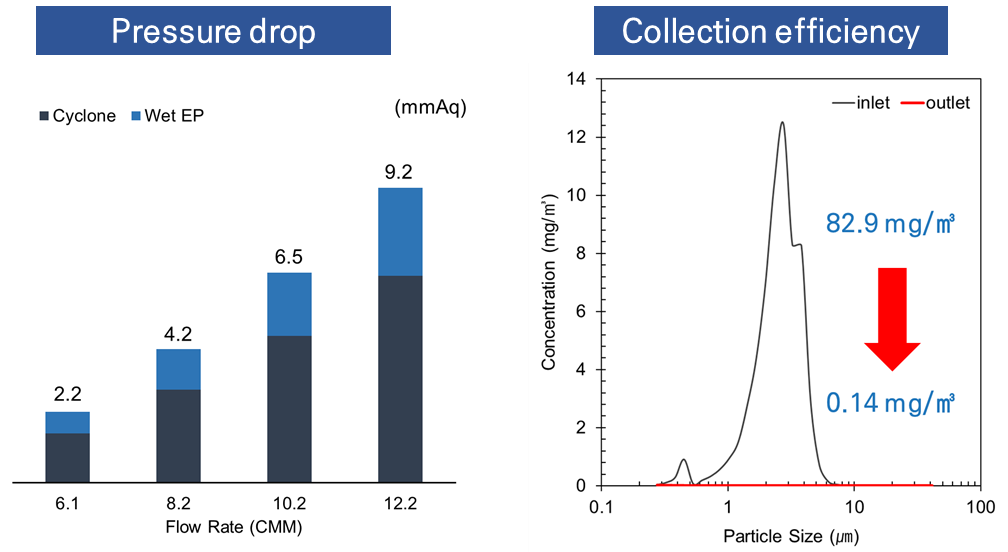
Experimental Environment — Target Gas: Exhaust gas from a textile dyeing plant in Daegu / Treatment Capacity: Exhaust gas flow rate of 10 m³/min
Demonstration Experiment Configuration — Co-current cyclone + spatial charging device + wet electrostatic precipitator
IP Status
| Patent Title | Application No. | Status |
|---|---|---|
| A Wet Electrostatic Precipitator for Fire Prevention and Its Method of Operation | PCT/KR2024/011304 | Application |
| A Wet Electrostatic Precipitator for Fire Prevention and Its Method of Operation | 10-2024-0038559 | Application |
| A Wet Electrostatic Precipitator Capable of Fire Prevention and a Method for Operating the Same | 10-2023-0148132 | Application |
| Wet Electrostatic Precipitator | 10-2160788 | Registration |
Applications
| Application Fields | Applicable Products |
|---|---|
|
|
TRL Stage
- 1
- 2
- 3
- 4
- 5
- 6
- 7
- 8
- 9
TRL 6
- Pilot-scale demonstration at a dyeing plant - Operation control and monitoring of facilities equipped with IoT devices - Full-scale (processing capacity of 300 CMM) demonstration test facility currently under construction