Korea Institute of Energy Research
Korea Institute of Energy Research (KIER)
K-LTSCR: An Industry-Specific Low-Temperature Denitrification Catalyst
Low-temperature denitrification catalyst technology that removes nitrogen oxides (NOx) with high efficiency (over 90%) even at low temperatures (180°C)
Technology Overview
A flue gas denitrification catalyst technology that removes more than 90% of nitrogen oxides even in low-temperature flue gas at 180 °C, where commercial SCR (Selective Catalytic Reduction) systems fail to perform optimally
We are currently conducting 100 Nm³/h-scale pilot demonstrations targeting flue gases from industrial sites such as cement kilns and steelmaking sintering furnaces to establish a database of operating conditions and design parameters for each industry; this technology enables compliance with stricter emission standards without the need to reheat the flue gas
Key Technology Features
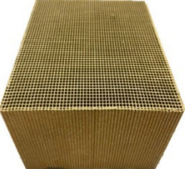
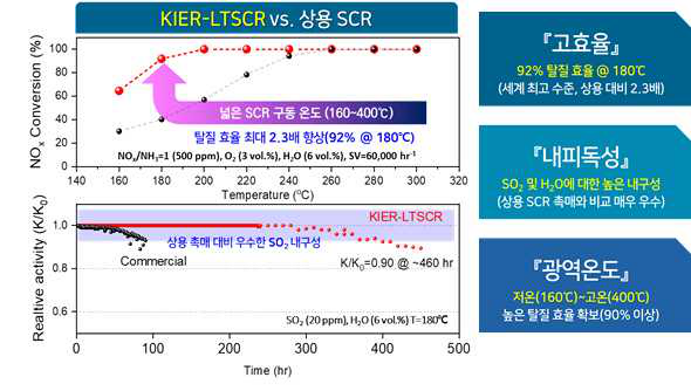
Low-temperature denitrification catalyst materials and manufacturing technology that achieve a denitrification efficiency of over 90% in the 180 °C low-temperature range
Operational technology that eliminates the temperature-rising load on existing SCR systems by accommodating a wide operating temperature range of 170–400 °C
Demonstration technology that utilizes a 100 Nm³/h-class pilot plant to verify performance and durability using actual flue gas from industrial sites and to derive problem-solving strategies
Catalyst module design and operational know-how tailored to the flue gas characteristics (sulfur, chlorine, and alkali components; temperature; flow rate) of each facility can be provided as a comprehensive package
Competitive Advantages of the Technology
Existing Technology | This Technology |
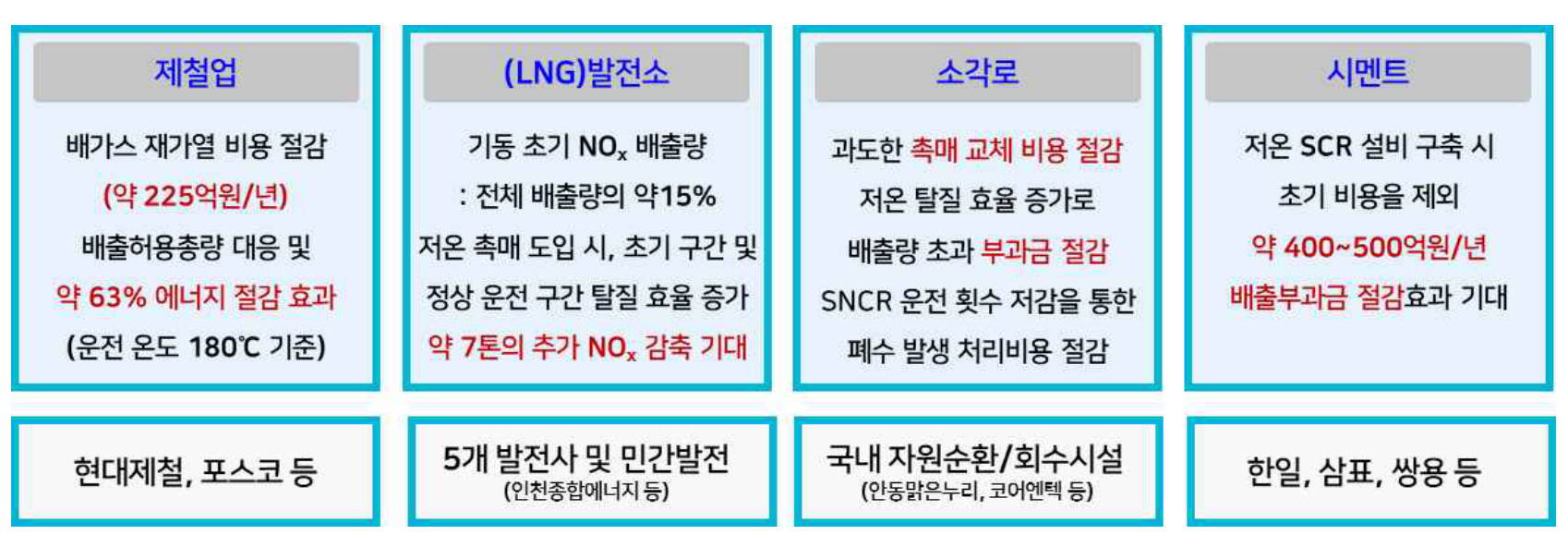
Commercial SCR systems operate normally only at temperatures above 250 °C, requiring the reheating of low-temperature exhaust gas; in the steel industry, 38% of the operating costs for exhaust gas purification equipment are consumed by the cost of heating the gas to the required temperature | By operating at 180°C, the reheating process is eliminated, enabling annual savings of approximately 22.5 billion won in reheating costs and energy savings of about 63% based on the steelmaking sintering process |
Catalysts currently supplied in Korea are V, W, and Ti-based low-to-medium-temperature types, whose denitrification efficiency drops sharply below 240°C; there are no documented cases of achieving an efficiency of 90% or higher at 180°C. | By achieving a denitrification efficiency approximately 30% higher than that of existing operating facilities in the low-temperature range (180–220°C), it is possible to meet emission standards even under stricter regulatory conditions |
Catalyst replacement cycles are short (2–3 months for incinerators) due to poisoning caused by sulfur, chlorine, and alkali components in the flue gas, resulting in significant replacement costs | With poisoning resistance five times that of commercial catalysts from overseas manufacturers (Companies C and S), the replacement cycle can be extended |
Experimental and Demonstration Data
During the initial startup phase of an LNG combined-cycle power plant, at temperatures below 200 °C or lower, where high concentrations of NOx are emitted, and efficiency in the low-temperature range (180–220 °C) improved by approximately 30% compared to SCR systems in existing facilities. It is estimated that this enables an additional annual reduction of approximately 7 metric tons of NOx at this power plant.
Compared to overseas catalysts (Companies C and S) supplied to commercial SCR facilities, this catalyst was confirmed to offer up to 2.3 times higher low-temperature denitrification efficiency and 5 times greater resistance to poisoning
Expected Benefits by Industry
Applications
| Application Fields | Applicable Products |
|---|---|
|
|
TRL Stage
- 1
- 2
- 3
- 4
- 5
- 6
- 7
- 8
- 9
TRL 6–7
TRL 6–7: A demonstration is currently underway (2024–2025) using a 100 Nm³/h-class pilot plant to evaluate performance and durability during 500 hours of continuous operation using actual flue gas.