Korea Institute of Energy Research
Korea Institute of Energy Research (KIER)
High-Power Solar Module Front Glass Utilizing Light-Conversion-Type Quantum Dots
Material and process technologies that coat the inner surface of the front glass of solar modules with quantum dots to convert previously wasted ultraviolet light into visible light, thereby increasing module output
Technology Overview
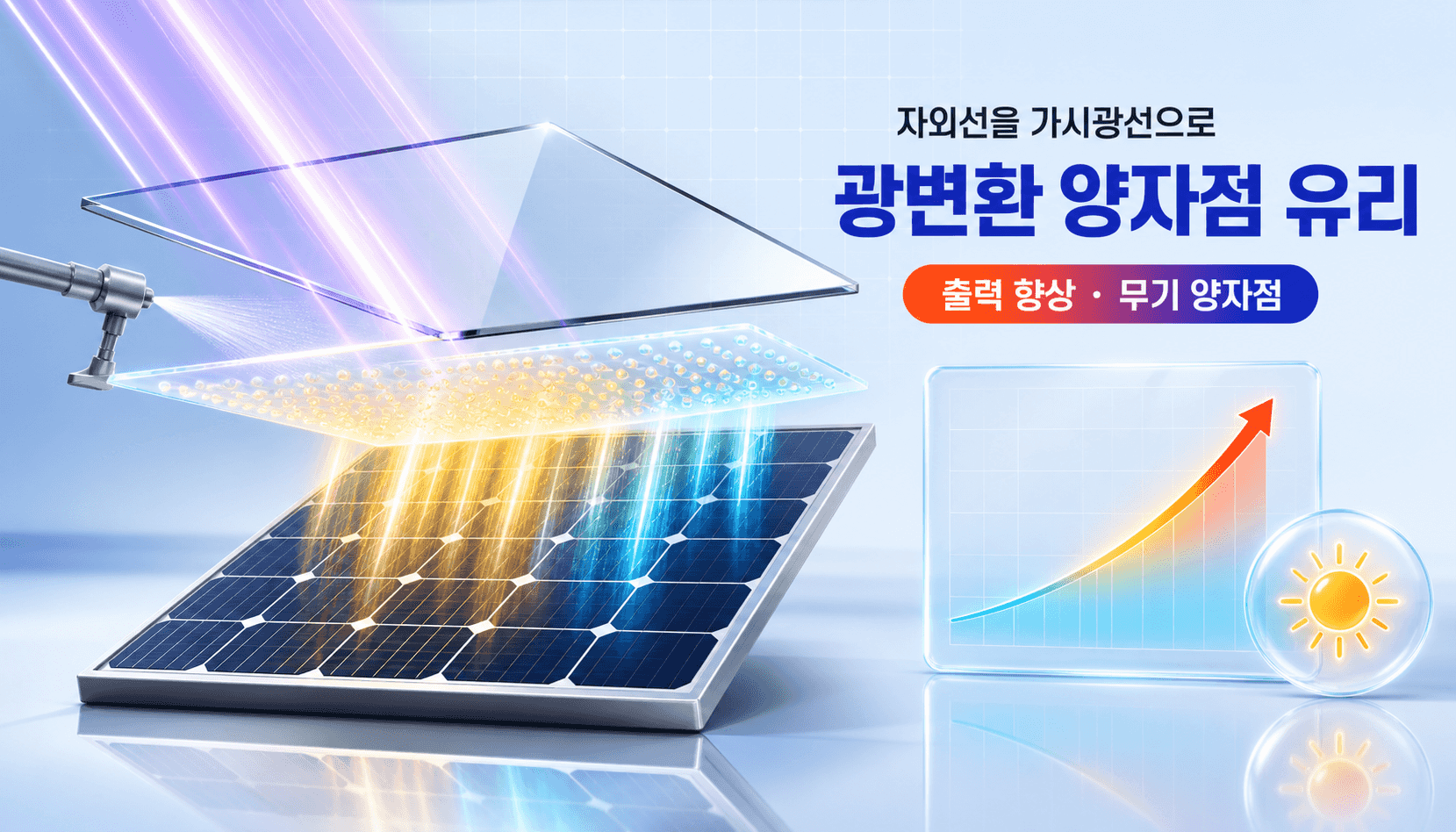
A material and process technology that increases module output by coating the inner surface of the front glass of a solar module with inorganic InP/ZnS quantum dots (QDs), which convert ultraviolet (UV) light—which solar cells cannot use for power generation—into visible light (down-conversion)
Since this method involves replacing only the glass substrate without altering the solar cell structure, it can be directly applied to existing module production lines and aims to improve the revenue structure of materials companies through the launch of a premium, high-output product line
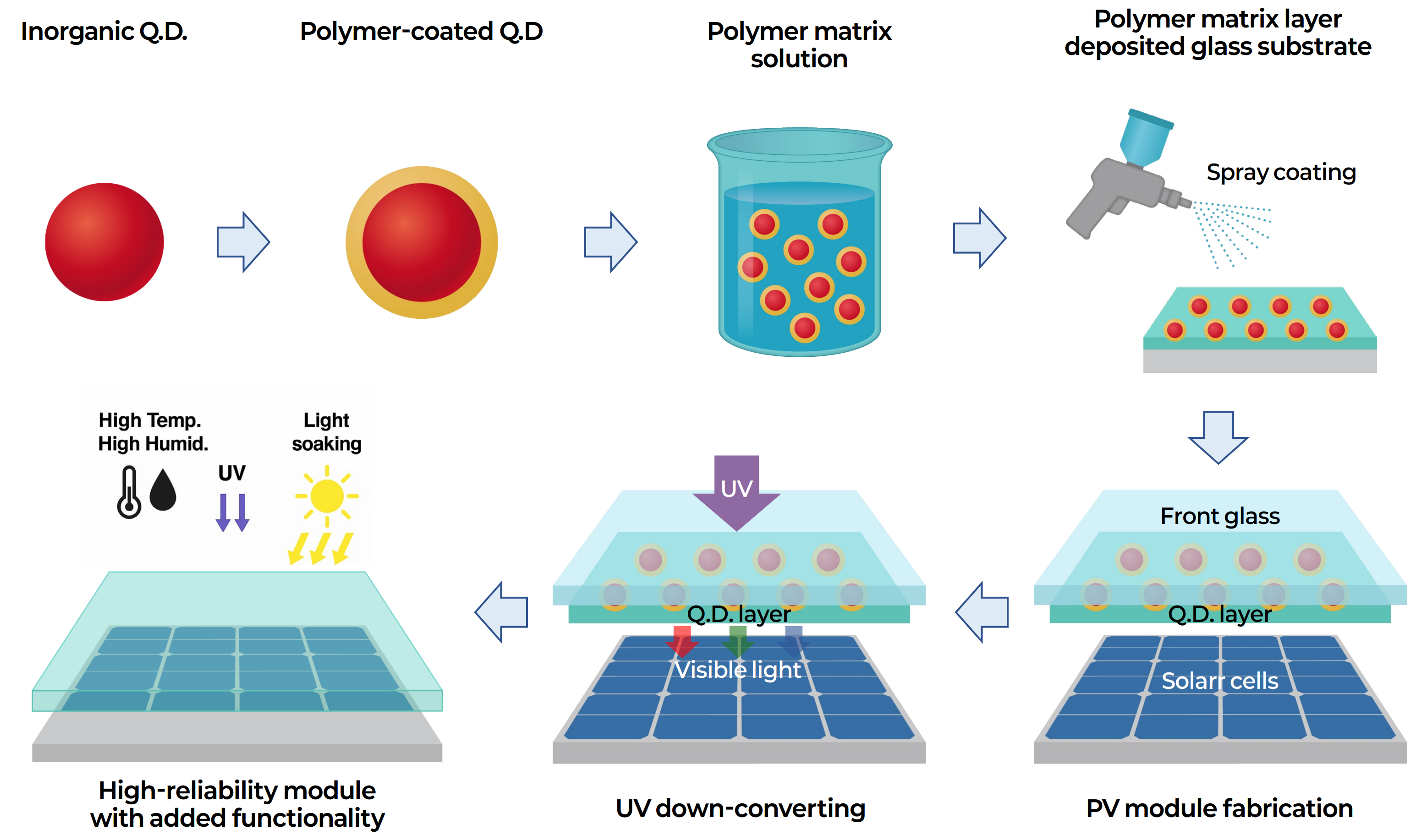
A solution containing inorganic QDs uniformly dispersed in a polymer matrix is spray-coated onto the inner surface of the front glass to form a photoconversion layer that converts ultraviolet light into visible light; this layer is then fed directly into the module lamination process
Technology Components
Solution preparation technology that disperses and stabilizes inorganic InP/ZnS core-shell quantum dots within a polymer matrix without agglomeration or precipitation (target: full width at half maximum [FWHM] of the emission wavelength ≤ 40 nm; polydispersity index [PDI] ≤ 0.15)
Process technology for precision coating the inner surface of large-area glass substrates using the EHD spray method (target film thickness of 100 µm or less, thickness uniformity within 10%)
Technology for manufacturing solar modules using Q.D.-coated glass and verifying power output improvement and long-term durability (including verification of compatibility with encapsulants such as EVA, POE, and EPE, and suitability for the lamination process)
Since power output is increased simply by replacing the glass substrate without changing the cell structure, the capital investment burden for existing mass production lines is minimal
Comparative Advantages of the Technology
Existing Technology | This Technology |
Module output improvements have primarily relied on enhancements to solar cell structure and electrodes, and the scope for further improvement is narrowing | This technology increases output through a novel approach—coating the inner surface of the front glass—and can be applied to existing production lines without modifying the cell structure. |
Organic quantum dot encapsulation films lack sufficient resistance to moisture and oxygen, making it difficult to ensure long-term performance stability in outdoor environments | This technology uses inorganic InP/ZnS quantum dots, which offer excellent heat resistance, moisture resistance, and photochemical stability, and are also advantageous in terms of low toxicity and environmental friendliness |
Ultraviolet (UV) light does not contribute to solar power generation and is wasted; in heterojunction (HJT) modules, which are vulnerable to UV light, it actually poses a burden. | Since UV light is converted into visible light and utilized for power generation, high-output HJT modules—which are relatively vulnerable to UV light—are expected to benefit the most. |
Applications
| Application Fields | Applicable Products |
|---|---|
|
|
TRL Stage
- 1
- 2
- 3
- 4
- 5
- 6
- 7
- 8
- 9
TRL 3–4
A stage for verifying the basic performance of materials and processes on a laboratory scale