

Korea Institute of Energy Research
Korea Institute of Energy Research (KIER)
An LCA-TEA-Based Process for the Resource Recovery of Carbon-Based Byproducts from Used Batteries to Achieve Zero Waste
A technology that uses ultrasonic purification to refine and achieve high purity in carbon-based sludge from used batteries, restores their performance through surface modification and carbon coating, and converts them into recycled graphite anode materials for high-performance rechargeable batteries
Technology Composition
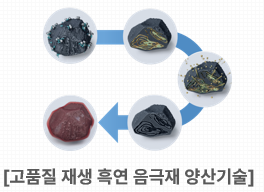
Using carbon by-products (recycled graphite) generated during the post-use battery recycling process as raw material, we produce recycled graphite anode material through a sequence of refinement, purification, and structural restoration
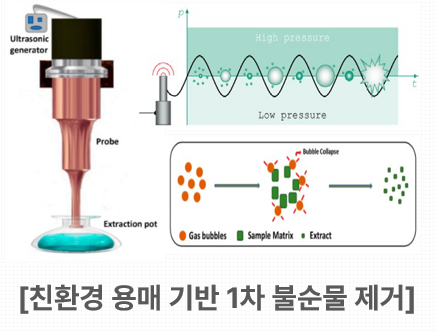
Primary Impurity Removal Using Eco-Friendly Solvents
Initial removal of impurities contained in carbon by-products via an ultrasonic-based purification process
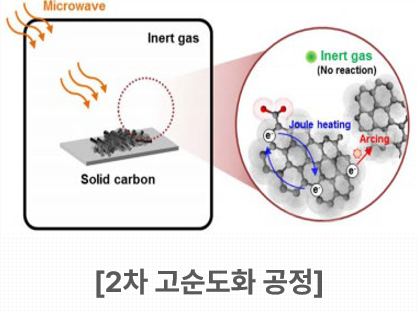
Secondary High-Purity Refining Process
A low-cost, high-purity refinement process utilizing carbon thermal shock reduces the impurity content to less than 1%.
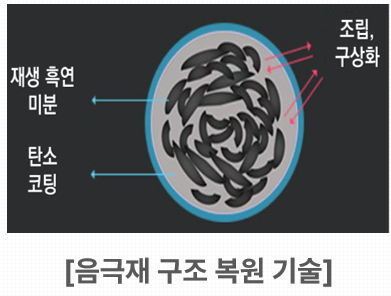
Anode Material Structural Restoration Technology
High-purity recycled graphite is finely ground, then agglomerated and spheroidized, and finally coated with carbon to produce high-performance recycled graphite anode material
Key Technical Details
Technology Overview
Technology that converts carbon-based sludge generated during the recycling of used batteries into high-value-added anode materials for rechargeable batteries through high-purity purification and functionalization
Background of Technology Development
Demand for lithium-ion batteries is rising due to the rapid growth of the electric vehicle (EV) and energy storage system (ESS) markets, leading to a sharp increase in the volume of end-of-life batteries.
Current recycling efforts focus on recovering high-value metals (such as lithium and nickel) from cathode materials, while anode materials (graphite), which account for approximately 32% of a battery’s mass, are mostly disposed of as industrial waste
Graphite is a material for which Korea is highly dependent on imports, making the stabilization of the supply chain an urgent priority
The global battery recycling market is projected to grow at a compound annual growth rate (CAGR) of 9.2%, reaching $19.8 billion in 2030 from $12.8 billion in 2025 (BCC Research, 2025).
The domestic battery recycling market is projected to grow at a compound annual growth rate (CAGR) of 5.9%, rising from $202 million in 2024 to $362 million in 2034 (Bonafide Research, 2025)
Comparative Technological Advantages
By combining ultrasonic-based primary refining with a low-cost secondary high-purity process, energy consumption is minimized, and a purity of over 99% is achieved through an environmentally friendly method
Through surface modification and carbon coating technologies, it is possible to mass-produce recycled graphite anode materials with electrochemical properties equal to or better than those of commercial battery-grade graphite
IP Status
| Patent Title | Application No. | Status |
|---|---|---|
| Method for Recycling Waste Carbon Resources and a Graphite-Silicon Composite for Rechargeable Battery Anodes Utilizing This Method | 10-2024-0031688 | Application |
| A Refining System and Recycling Method for Waste Carbon Resources Using Density Differences | 10-2023-0127240 | Application |
Applications
| Application Fields | Applicable Products |
|---|---|
|
|
TRL Stage
- 1
- 2
- 3
- 4
- 5
- 6
- 7
- 8
- 9
TRL Level 4
Laboratory-Scale Performance Evaluation of Components and Systems